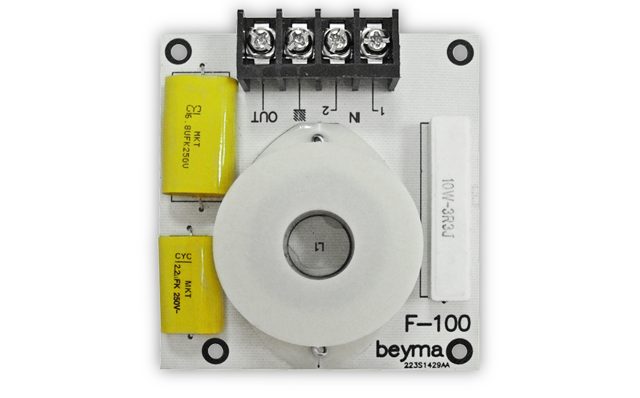
BEYMA F-100
BEYMA F-100 — Crossover
300 W AES
Part no.: 42A-CHS-FW-BEY-0008
Documents
BEYMA F-100 — Crossover
300 W AES
Technical data
- Power handling: 300 W AES
- Weight: 1 kg
Series: F · Part no.: 42A-CHS-FW-BEY-0008
Beyma F-100: passive F-series crossover, 300 W AES, 1 kg
Beyma's F series comprises passive crossovers for two-way loudspeakers, and the F-100 is one of the two models from this range carried by 42.audio. With 300 W AES power handling and 1 kg weight it is compact enough for monitors and small tops yet strong enough to run on a full-size PA amplifier. The crossover does three jobs at once: distributing the signal by frequency to the LF and HF branches, attenuating the louder HF unit to the level of the woofer, and protecting the HF unit from signal below its working range.
Passive crossovers are always tuned for specific drivers, because the filter curve depends on the impedance of the connected units, not just on the component values. Beyma designs the F-series networks for combinations from its own catalogue, and that is exactly where the F-100 should be used. The 300 W AES describes the rating of the crossover itself, meaning the power its inductors and capacitors can sustain continuously.
Use and enclosure
Where the F-100 belongs is a classic two-way loudspeaker made of a Beyma woofer and a Beyma compression driver on a horn, driven from a single amplifier channel. That is the standard architecture for stage monitors, small full-range cabinets and installation speakers where no DSP is to be built in. Before you plan around this crossover, find out which driver combination Beyma intends it for and compare the driver data in the driver database at 42.audio, particularly sensitivity and impedance.
During assembly it pays to mount the crossover on its own panel inside the cabinet and to keep the leads to the drivers short. At 1 kg it is light enough to sit on a cabinet wall without working loose in transport, provided it is bolted down properly. After wiring, check the polarity of both branches, because a phase error at the transition cannot be corrected by equalisation.
What to look out for
- Two-way crossover from the Beyma F series, 300 W AES power handling.
- 1 kg weight, easy to accommodate in monitors and compact tops.
- Use only with the driver combinations Beyma intends it for.
- Keep leads short, check polarity at woofer and HF unit.
- No substitute for a limiter: driver power handling remains the deciding factor.
Frequently asked questions
What is the difference between the F-100 and the other F-series model?
Both belong to the F series and are identical in rating and weight at 300 W AES and 1 kg. The difference lies in the tuning for different driver combinations, meaning crossover frequency and attenuation. Which crossover you need follows from the drivers you build with.
Do I still need a controller with this crossover?
Not for the split inside the two-way cabinet. A controller or DSP ahead of the amplifier remains useful for limiting, subwoofer integration and equalisation, but it does not interfere with the passive split.
How do I wire the crossover?
Input to the amplifier, the two outputs to woofer and HF unit. Keep the polarity consistent between crossover output and driver. If in doubt, measure the frequency response around the transition: a clear dip indicates reversed polarity.
At 42.audio you get the BEYMA F-100 with all key data in the driver database. More drivers from this manufacturer: Atlas Beyma.
Specifications
| Allgemein | |
|---|---|
| Manufacturer | BEYMA |
| Category | Crossover |
| Series | F |
| Power handling (W) | 300 |
| Abmessungen & Korb | |
|---|---|
| Weight (kg) | 1 |