18SOUND 15ND930
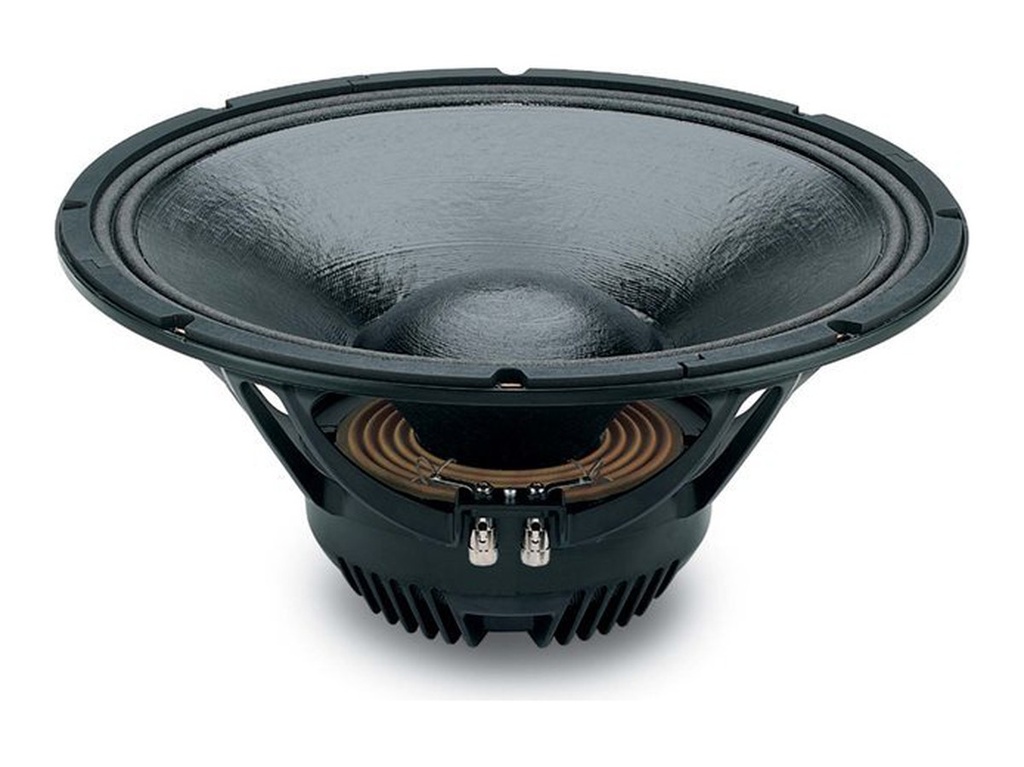
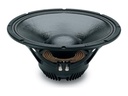
18SOUND (Eighteen Sound) 15ND930 — 15" / 15 inch · Woofer/Midrange (WM) · Subwoofer / Bass · Neodymium
3" voice coil · 8 Ω
Part no.: 42A-CHS-TT-18S-0052
Documents
18SOUND 15ND930 — 15" · Woofer
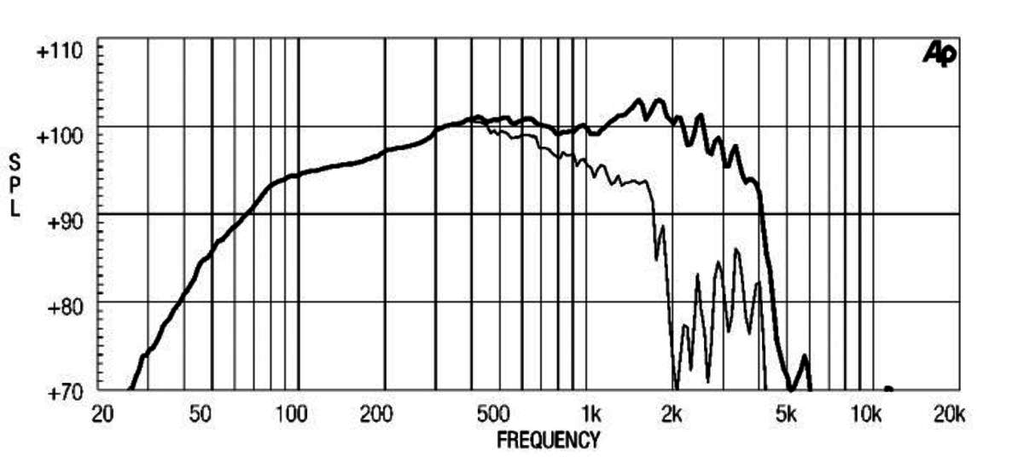
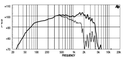
500 W AES · 98 dB Sensitivity · Frequency range 40 Hz – 4100 Hz
Technical data
- Diameter: 15 "
- Voice coil: 3 "
- Power handling: 500 W AES
- Sensitivity: 98 dB
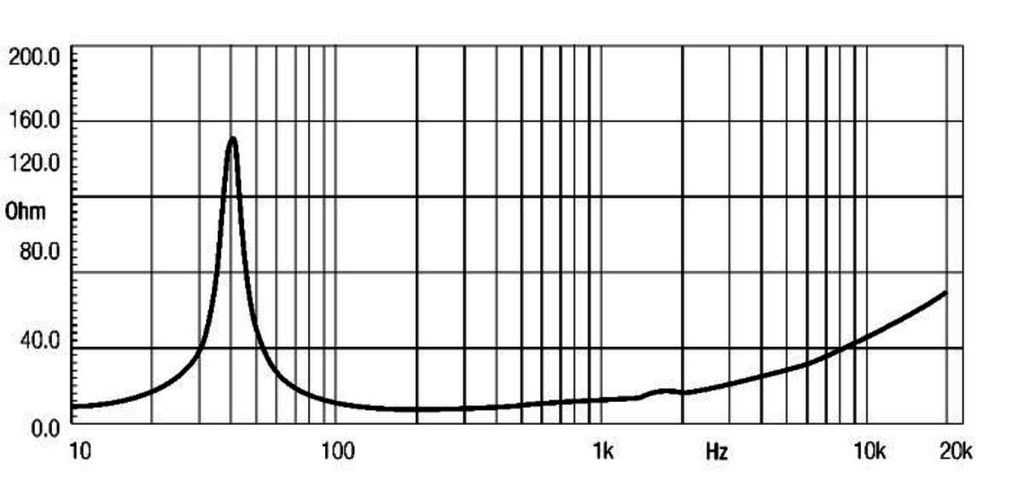
- Impedance: 8 Ω
- Magnet: Neo
- Weight: 4.7 kg
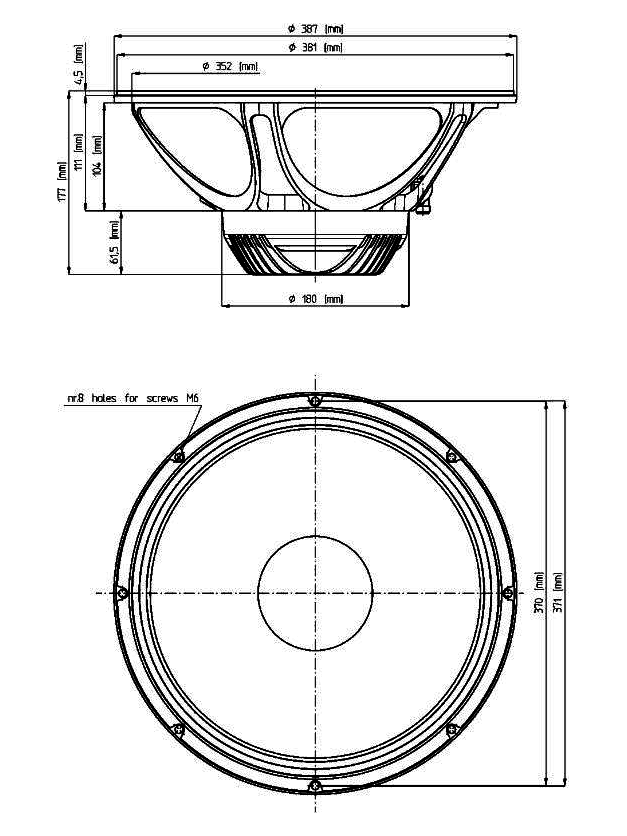
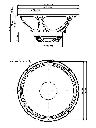
- Mounting depth: 177 mm
- Frequency range: 40 – 4100 Hz
Datasheet (PDF) · Manufacturer page
Series: ND · Part no.: 42A-CHS-TT-18S-0052
18Sound 15ND930: 15" neodymium woofer with Qts 0.22 and 23.8 Tm for horn loading
A Qts of 0.22 makes a statement: with 23.8 Tm the 18Sound 15ND930 has the strongest motor among the woofer/midrange models of the ND series, making it a driver for horn loading and very compact vented boxes. The neodymium unit weighs 4.7 kg, carries a 3" voice coil, handles 500 W AES and delivers 98 dB sensitivity across 40 to 4,100 Hz.
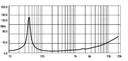
The remaining parameters complete the picture: Fs 36 Hz, Vas 206 l, Qms 5.3, Qes 0.23, a moving mass of 101 g and 7.5 mm Xmax. Low resonance combined with a very low Qts is the classic signature of a horn bass driver: compliant suspension, heavily damped by the motor. The EBP is 157, the highest value in this product group.
Use and enclosure
The classic approximation formulas give the 15ND930 a vented box of only about 40 l tuned to 59 Hz, with a lower cut-off around 78 Hz. For a pure vented top that is a very compact but not particularly deep alignment; in practice many designers with such a low Qts choose larger volumes with lower tuning and correct the shallower roll-off with DSP. Sealed, the figure is 22 l with a system resonance near 116 Hz, in other words a midrange chamber for 3-way systems with a high crossover. For such variants the enclosure calculator at 42.audio is the right tool.
The true domain of the 15ND930 is horn loading: the strong motor drives the cone against the acoustic load of a bass horn without losing control, and the 7.5 mm Xmax is sufficient there because the horn reduces excursion demand. In line-array elements and mid-high modules with a high crossover it exploits its bandwidth up to 4,100 Hz. Mounting depth is 177 mm, inductance 1.61 mH.
What to look out for
- Qts 0.22, BL 23.8 Tm: for bass horns and compact vented boxes, not for large cabinets.
- Fs 36 Hz with EBP 157: low resonance, but very tightly damped.
- 500 W AES, 7.5 mm Xmax: sufficient in a horn, set a limiter in a vented box.
- 4.7 kg neodymium, 177 mm mounting depth.
- Re 5.5 Ω, 8 Ω nominal, also available in 4 and 16 Ω.
Frequently asked questions
What is the difference between the 15ND930 and the 15W930?
Both have Qts 0.22; the 15W930 with 33 Hz Fs and 240 l Vas is the ferrite version with even lower resonance and larger Vas. The 15ND930 is much lighter at 4.7 kg and extends further into the midrange with 4,100 Hz.
Is the 15ND930 a good subwoofer driver?
In a bass horn, yes, where the strong motor is exactly what is needed. As a vented subwoofer it is less ideal with 7.5 mm Xmax and its very low Qts; drivers with more excursion and higher Qts deliver extension more easily there.
Why is the guideline box so small at 40 l?
With Qts 0.22 the classic formulas yield a small volume with a high tuning frequency. That is not an error but the nature of a horn-optimised driver; if you want more extension in a vented box, go deliberately larger and lower and accept the shallower roll-off.
At 42.audio you get the 18SOUND 15ND930 with datasheet PDF, all key data in the driver database and the enclosure calculator. More drivers from this manufacturer: Atlas 18Sound.
Thiele-Small parameters
| Nominal impedance | 8 Ω |
|---|---|
| Resonance frequency fs | 36 Hz |
| Total Q Qts | 0.22 |
| Electrical Q Qes | 0.23 |
| Mechanical Q Qms | 5.3 |
| Equivalent volume Vas | 206.0 l |
| Moving mass Mms | 101.0 g |
| Cone area Sd | 850 cm² |
| Linear excursion Xmax | 7.5 mm |
| Force factor BL | 23.8 Tm |
| DC resistance Re | 5.5 Ω |
| Voice coil inductance Le | 1.61 mH |
Enclosure suggestion
The EBP of 157 suggests a bass-reflex enclosure. EBP = fs / Qes = 36 / 0.23
Sealed (Qtc 0.707)
- Enclosure volume Vb
- 22.1 l
- System resonance Fc
- 116 Hz
- Cut-off frequency F3
- 116 Hz
Bass reflex (QB3 after Small)recommended
- Enclosure volume Vb
- 27.9 l
- Tuning frequency Fb
- 67 Hz
- Cut-off frequency F3
- 87 Hz
Vb is the required net internal volume, Fb the tuning frequency of the reflex port and F3 the frequency at which the level has dropped by 3 dB. Calculated approximation after Small. A starting point for simulation, not a finished build plan.
Comparable drivers
Same size, same type, Qts within ±30 %.
- B&C Speakers 15NDL76fs 37 Hz · Qts 0.22 · Vas 195 l · in the database
- B&C Speakers 15SW115fs 34 Hz · Qts 0.22 · Vas 105 l · in the database
- 18 Sound 15W930fs 33 Hz · Qts 0.22 · Vas 240 l · in the shop
- B&C Speakers 15NW100fs 33 Hz · Qts 0.22 · Vas 139 l · in the database
- B&C Speakers 15NW76fs 42 Hz · Qts 0.22 · Vas 130 l · in the database
- B&C Speakers 15NW100fs 34 Hz · Qts 0.23 · Vas 126.1 l · in the database
Specifications
| Allgemein | |
|---|---|
| Manufacturer | 18SOUND |
| Category | Low Frequency |
| Series | ND |
| Magnet | Neo |
| Impedance (Ω) | 8 |
| Power handling (W) | 500 |
| Sensitivity (dB) | 98 |
| Frequency from (Hz) | 40 |
| Frequency to (Hz) | 4100 |
| Abmessungen & Korb | |
|---|---|
| Diameter | 15 |
| Voice coil (inch) | 3 |
| Mounting depth (mm) | 177 |
| Weight (kg) | 4.7 |
| Thiele-Small-Parameter | |
|---|---|
| Re (Ω) | 5.5 |
| Le (mH) | 1.61 |
| Fs (Hz) | 36 |
| Qms | 5.3 |
| Qes | 0.23 |
| Qts | 0.22 |
| Vas (l) | 206 |
| Xmax (mm) | 7.5 |
| BL (Tm) | 23.8 |
| Mms (kg) | 0.101 |
| Sd (m²) | 0.085 |